
By aligning his artistic ambitions with the political goals of Sun Yat-sen’s Tongmenghui (Chinese Revolutionary Alliance), Cantonese artist Gao Jianfu (1879–1951) articulated the aspirations of a generation. Together with his brother Gao Qifeng (1889–1933), and statesman-artist Chen Shuren (1884–1948)—later known collectively as the Lingnan School—their work shaped global perceptions of modern Chinese painting. This talk draws on the M+ exhibition Canton Modern: Art and Visual Culture, 1900s–1970s, which examined the works of artists from Guangdong and Hong Kong whose lives shared the traumas of revolution, war, and displacement. Collectively, their practices advocate for the agency of art and artists to shape the cultural and political worlds they inhabited.
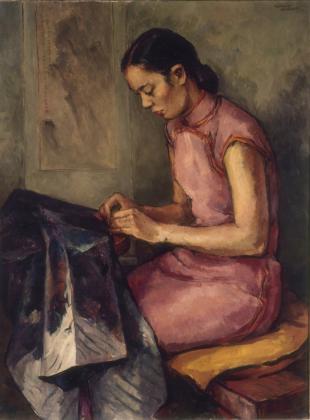
Wong Siu-ling (1909–1989); Sewing for You, 1941; oil on canvas; 122 x 92 cm; Collection of the Hong Kong Museum of Art. Donated by Ms Jeanette Hsu. Acc.no: AC1991.0022.
807 Schermerhorn Hall
RSVP for campus access QR code: mo2486@columbia.edu
By aligning his artistic ambitions with the political goals of Sun Yat-sen’s Tongmenghui (Chinese Revolutionary Alliance), Cantonese artist Gao Jianfu (1879–1951) articulated the aspirations of a generation. Together with his brother Gao Qifeng (1889–1933), and statesman-artist Chen Shuren (1884–1948)—later known collectively as the Lingnan School—their work shaped global perceptions of modern Chinese painting. This talk draws on the M+ exhibition Canton Modern: Art and Visual Culture, 1900s–1970s, which examined the works of artists from Guangdong and Hong Kong whose lives shared the traumas of revolution, war, and displacement. Collectively, their practices advocate for the agency of art and artists to shape the cultural and political worlds they inhabited.